
#AIforNature #NBS #MRV #Biodiversity #GBF #FirstMileData #CarbonMarkets
The World Resources Institute has published AI for Nature: How AI Can Democratize and Scale Action on Nature, a working paper dated November 2025 and released on 4 November. It carries WRI and Google logos on its cover, has seven authors, and states in its acknowledgments that “the authors extend their gratitude to Google for providing funding for this work”. Two of the seven authors are Google employees, two are at WRI, two are at Vizzuality and one is a strategy consultant and design thinking facilitator. The paper is available from wri.org.
The paper is a synthesis, not a study. Its evidence base is 22 video interviews conducted between 13 May and 27 June 2025, recruited by snowball method, together with an “exploratory, non-systematic literature review” and a set of case studies selected on the criterion that “preference was given to case studies that have demonstrated real-world outcomes”. Transcripts were analysed thematically, “further using Gemini 2.5 Flash and Notebook LM to support synthesis and thematic generation in compliance with WRI’s Generative AI Guidelines”, with all transcripts manually reviewed and all generated outputs validated by the research team.
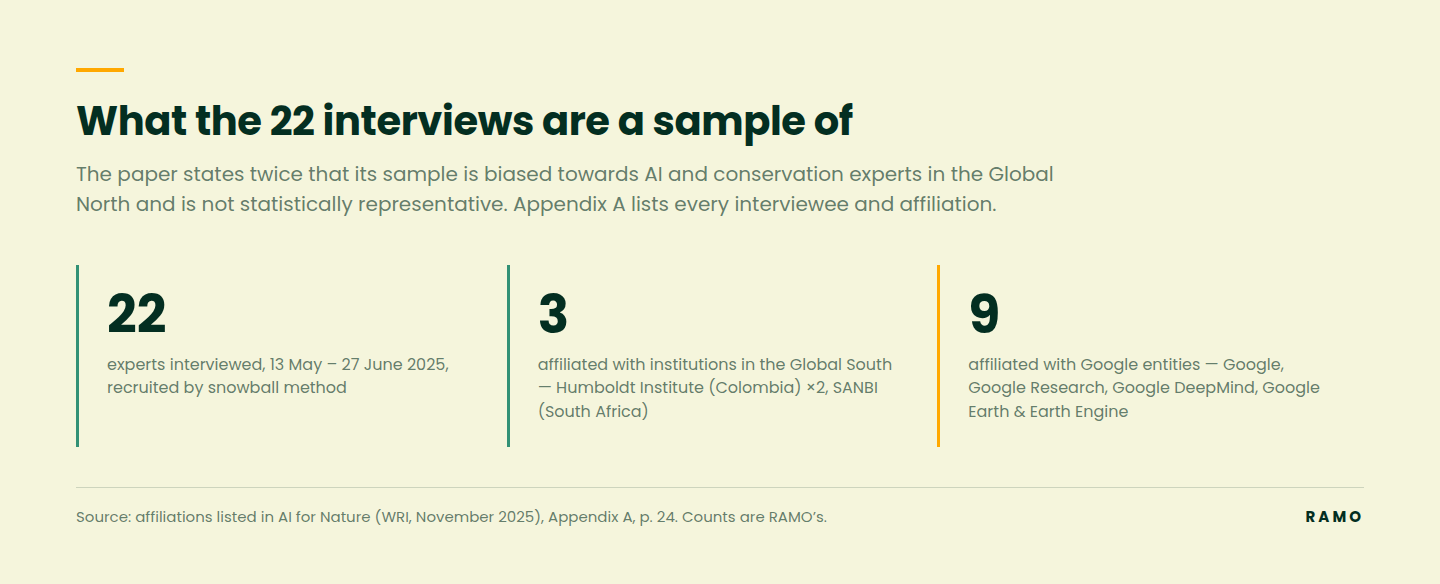
The paper is unusually direct about the limits of that base. It states twice that “the sample is biased towards AI and conservation experts in the Global North and is not a statistically representative sample of the field”. That disclosure is worth more than it might appear, and it is the right lens for reading everything that follows.
What follows sets out the three barriers the paper identifies, the evidence it offers for each, where it locates the binding constraint, and what it leaves unresolved.
The paper organises its findings around three barriers to nature action that it argues AI can address: monitoring — transparent observation of who or what is causing nature loss, at a granularity useful for local decisions; accessibility — the people who could act on that information frequently cannot reach it; and complexity — the interactions between human and natural systems make optimal interventions hard to identify.
The scale of the first is stated plainly. In a 2024 review of challenges to achieving the Kunming-Montreal Global Biodiversity Framework, 73 percent of countries reported lack of information and data as a key barrier, second only to financing. Fewer than 25 percent of countries have clear goals and plans aligned with the GBF. As of September 2025, 55 countries had submitted voluntary action plans setting out how they would meet GBF goals — against 196 countries that adopted the framework in 2022. UNEP’s estimate of the shortfall in global financing for nature, cited in the paper, is USD 500 billion per year.
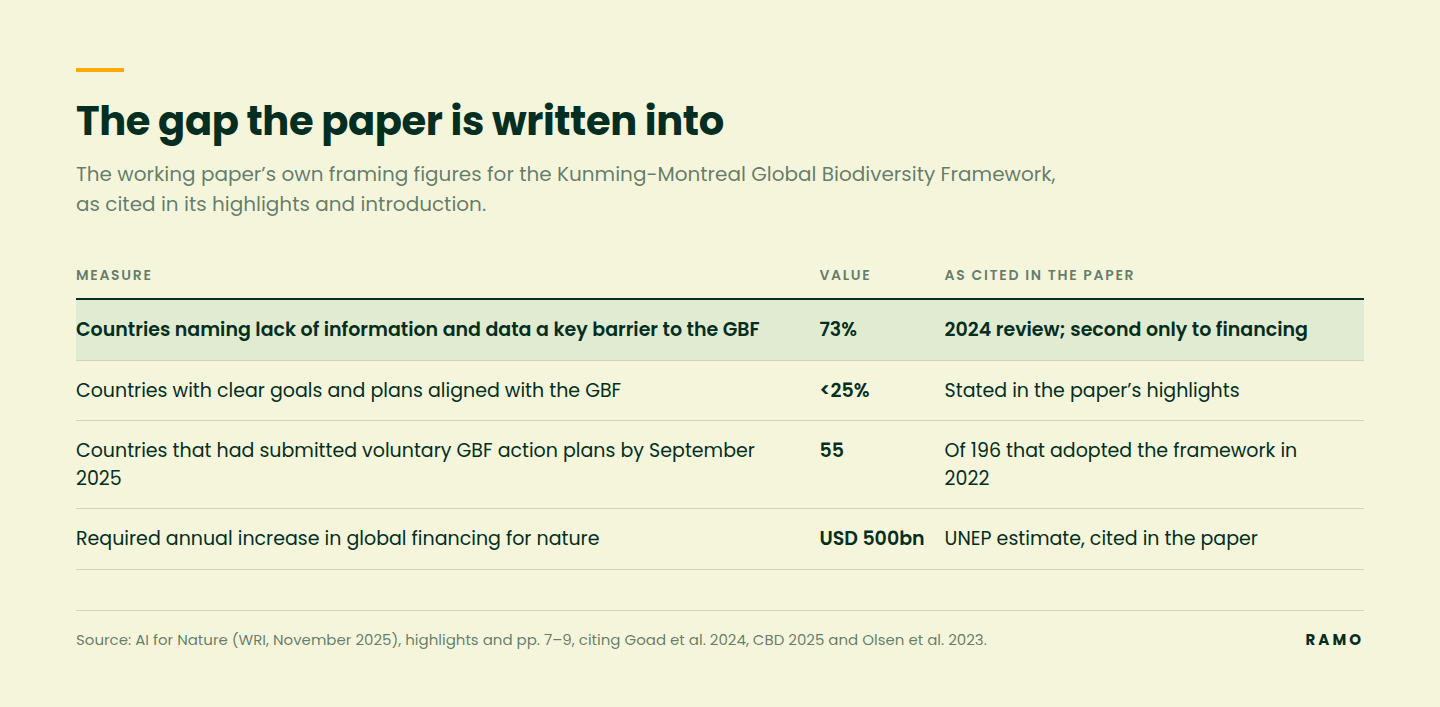
Figure 2 of the paper maps the three barriers against five actor groups — communities, practitioners, civil society, corporations, policy — shading each cell by relevance. It is the paper’s central organising device and it is useful. It is also, by the paper’s own note, “based on the authors’ synthesis of interviewee perspectives and the literature review”, which is to say a considered judgement rather than a measurement. Read it as a map of where the authors believe attention should go, not as a finding.
Three boxed case studies carry most of the paper’s demonstrative weight, with Global Forest Watch appearing in the running text. Their figures are substantial.
Wildlife Insights, released in 2019, holds what the paper calls the world’s largest publicly accessible database of camera trap images: 253 million images, including 83.6 million verified wildlife images of 4,292 species, used by over 20,000 researchers and conservationists across 112 countries. Its SpeciesNet model is reported, on average, at 98.7 percent accuracy in detecting the presence of an animal and 94.5 percent in identifying the species. MegaDetector, the related detection model, is cited as increasing manual processing speed for detecting animals in images by 840 percent. Both are available as open-source software.
iNaturalist’s computer vision model can identify 101,000 taxa as of 2025. Its community of over 400,000 contributors has supplied more than 100 million research-grade observations to the Global Biodiversity Information Facility, supporting open range maps of over 100,000 taxa and over 6,500 scientific publications.
Global Fishing Watch, launched in 2015 by Google, SkyTruth and Oceana, is credited with two specific outcomes, one enforcement and one designation: Chilean authorities used its data in 2024 to enforce seasonal toothfish closures, resulting in fines for 21 vessels; and its data enabled the designation of the largest marine protected area in North America in 2017.
Global Forest Watch appears through a 2021 study finding that deforestation rates fell 52 percent after indigenous community groups in Peru were provided with real-time deforestation alerts.
These are real outcomes and the paper is right to cite them. Two qualifications matter for anyone reading the paper as an investment case. First, the platform-scale figures — images held, users, taxa, observations — are as reported by the operators, several of them sourced to personal communications, and the selection criterion (preference for case studies with demonstrated outcomes) selects for success by construction. The two outcome figures that carry independent evidence are the peer-reviewed ones: MegaDetector’s processing speed-up (Fennell et al. 2022) and the Peru deforestation result (Slough et al. 2021). Second, of the three boxed case studies two are Google-founded or Google-co-founded on the paper’s own account, the fourth example is WRI’s own platform, and the paper is Google-funded. None of that makes the numbers wrong. It does mean the case studies describe what a well-resourced, open-data platform can achieve, rather than what a typical practitioner should expect.
The paper’s recommendations are three: invest in primary data collection, develop open and accessible models, and invest in capacity sharing. Figure 1 arranges them as a feedback loop — “better data beget better models, open models are adapted to empower local actors, and capacity sharing enables on-the-ground action and the collection of more representative data.”
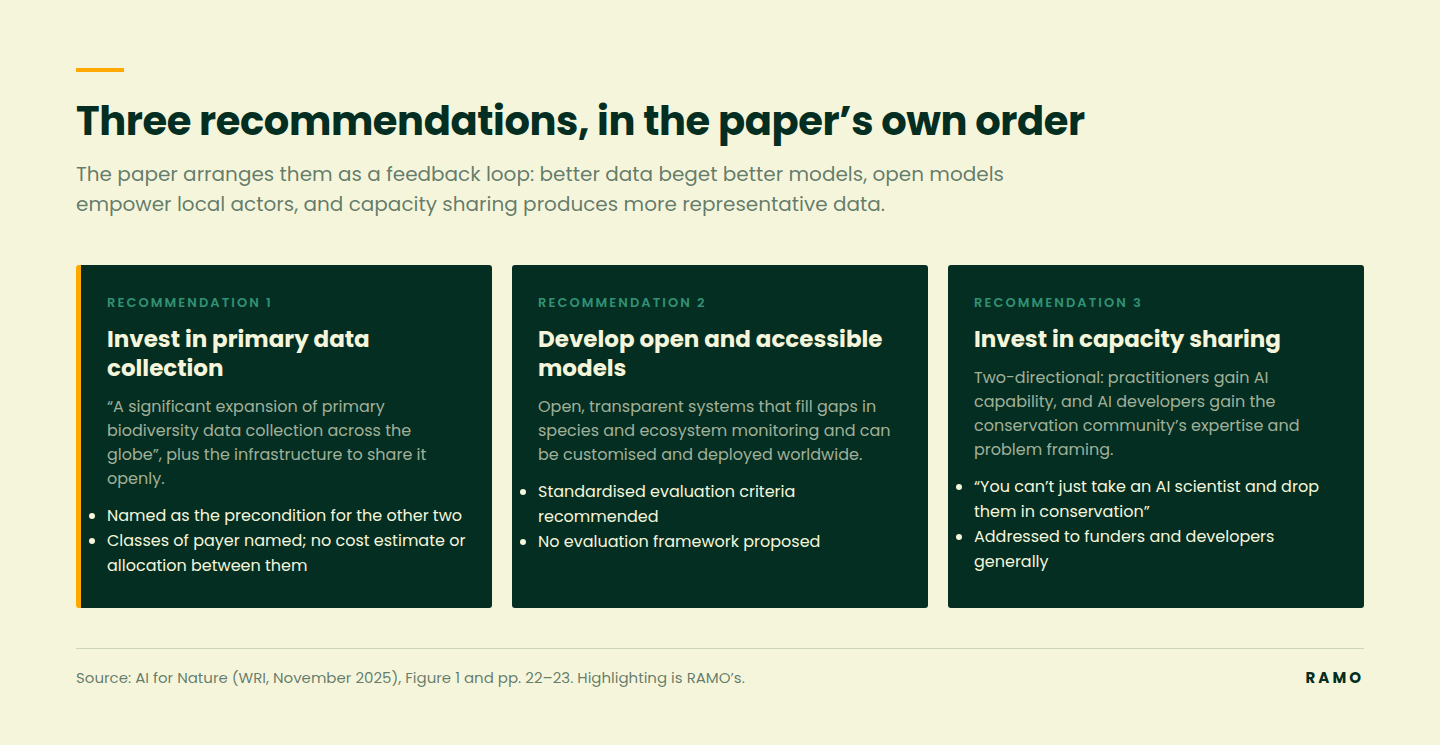
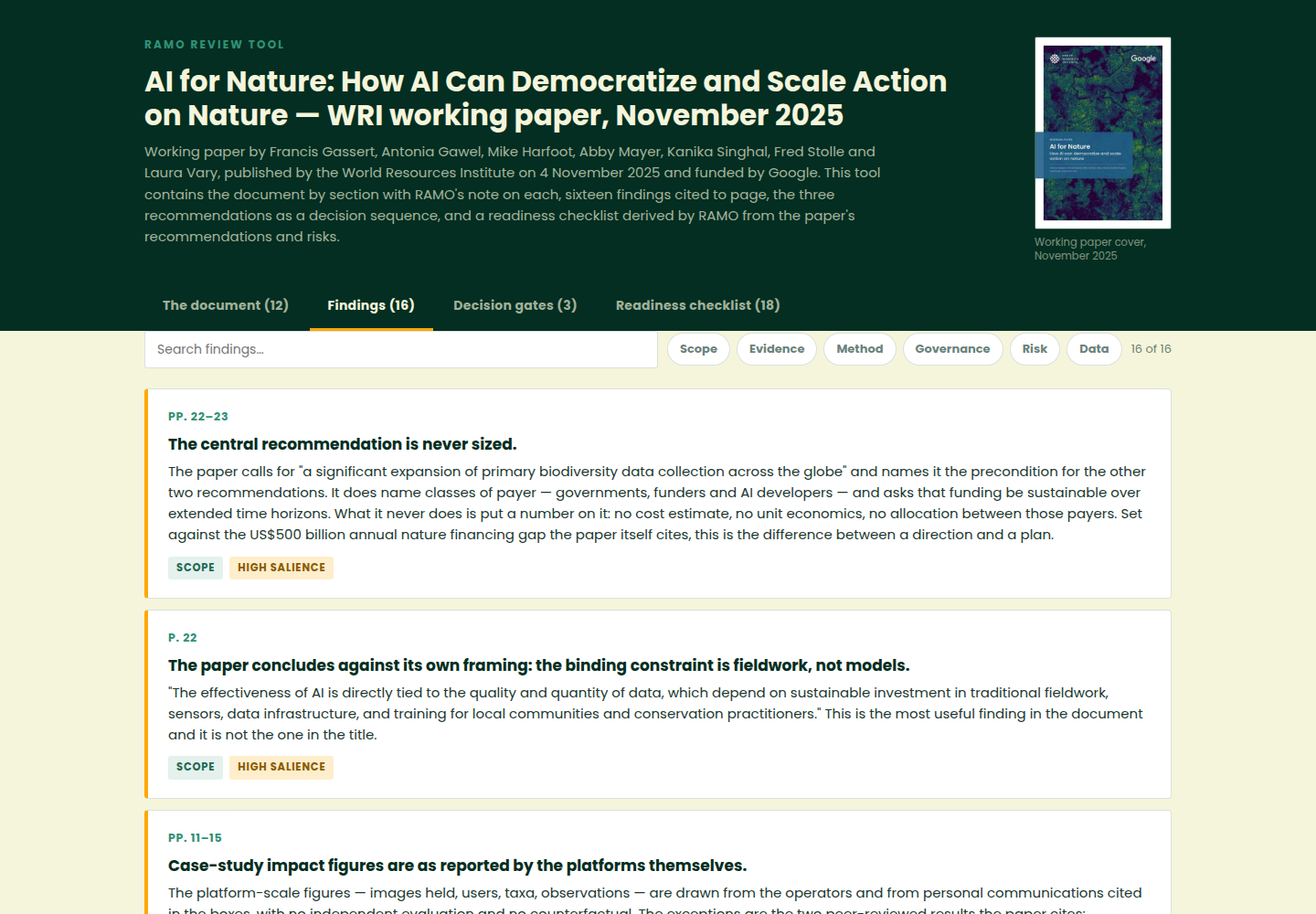
The first of the three is doing the work. The paper states it directly: “The effectiveness of AI is directly tied to the quality and quantity of data, which depend on sustainable investment in traditional fieldwork, sensors, data infrastructure, and training for local communities and conservation practitioners.”
Its interviewees put it more sharply. Sara Beery of MIT: “People spend a lot of time trying to sell models [but] models are only as good as the data […]. Data is never a bad investment, and data that can be open-sourced and have mutual and diverse downstream uses; that is the no-regret investment.” Barbara Han of the Cary Institute of Ecosystem Studies, on the maintenance problem: “AI needs data, and the data need to be cleaned and curated. […] [Scientists] put in a ton of effort to build these databases […] and then there’s no scaling because nobody wants to fund the maintenance, but it’s fundamentally what […] AI requires to produce anything of value.” Stephanie O’Donnell of the World Bank’s Global Wildlife Program: “Finding the right people and helping them collaborate, build capacity to problem solve and work together is way more […] important than the technology applications.”
The paper’s own conclusion follows: “Ultimately, AI should be seen as an enabler that strengthens—rather than replaces—human-led efforts to safeguard the natural world.”
A paper written to argue that AI can democratise and scale action on nature concludes that the binding constraint is fieldwork, curation and people. That is a more useful finding than the title suggests, and a more honest one.
Five risk headings are set out: bias and accuracy, access to AI, data access and protections, environmental impact, and the limits of technology.
On bias, the paper quotes Maria Cecilia Londoño Murcia of the Humboldt Institute in Colombia: “The problem is that the training of the models is usually done with data from the Global North and not from the Global South. So, when we are applying those models in countries like Colombia, we find a lot of different and unexpected results.” On environmental impact, it cites a 2025 International Energy Agency report putting data centres at approximately 1.5 percent of global electricity use, projected to double by 2030.
Each risk carries a “mitigation actions” subsection. These are addressed to categories of actor — AI developers, policymakers, funders, the conservation community. Institutions are named, but as examples to emulate rather than as parties responsible, and no mitigation carries an accountable owner, a date or a budget. The paper recommends the development of “nature-specific benchmarks or evaluation criteria”; it does not propose one.
Three things are unresolved in the text, and each is consequential for anyone acting on it.
The central recommendation is never sized. The paper calls for “a significant expansion of primary biodiversity data collection across the globe” and names it the precondition for everything else. It does name classes of payer — governments, funders and AI developers — and asks that funding for the infrastructure be sustainable over extended time horizons. What it does not do is put a number on it: no cost estimate, no unit economics, no allocation between those payers. Set against the USD 500 billion annual nature financing gap it cites, the omission is the difference between a direction and a plan.
Representation in the sample is disclosed, not corrected. The paper discloses its Global North bias twice and does not adjust for it. On our reading of Appendix A, 9 of the 22 interviewees are affiliated with Google entities and 3 with institutions in the Global South. The paper’s own diagnosis — that AI expertise and infrastructure are concentrated in a handful of countries — is visible in its own sample, which the disclosure acknowledges but the findings do not weight.
The capability baseline is already stale, and says so. The paper notes that “none of the studies cited above used the latest generation of ‘reasoning’ LLMs, such as Gemini 2.5 Pro and GPT-5, implying that current capabilities exceed what we document here”. Figure 4, which shows publications on AI and nature rising sharply from 2018, is normalised such that 2024 = 100, with 2025 values projected rather than observed.
None of the three is a defect of scholarship. They are the boundaries of what a synthesis of this kind can deliver, and the paper is candid about all three. They do determine how the document should be used: as a well-sourced map of the terrain, not as a basis for allocating capital.
The rest of this piece describes the document. This section is our reading of it.
The paper’s most valuable contribution is not its case for AI. It is the conclusion it reaches against its own framing: that the effectiveness of AI is bounded by primary data, and that primary data means traditional fieldwork, curation and trained people in the places where the data are missing. That is the same constraint we described in our reading of Gaining Ground and again in Kenya’s carbon markets guide, where forestry and land use were excluded from the Article 6 whitelist on the stated grounds that baseline data were not yet credible enough for the state to underwrite a corresponding adjustment against.
Three documents, three different authors, one constraint. The instrument that is missing is not a model. It is a defensible measurement of a specific piece of ground.
Our experience is that closing that gap is expensive, unglamorous and specific. In one Angolan programme, RAMO produced a high-resolution biomass and carbon assessment from LiDAR aerial survey: point-cloud classification, manual removal of non-vegetative artefacts, terrain, surface and canopy-height model generation, land-use-specific allometric biomass estimation, above- and below-ground modelling, and conversion to CO₂e — with the QA/QC record that makes each step reviewable. The work earned a letter of recommendation from the Angolan government. There is no version of that output that a foundation model produces without the flight, the plots and the allometry.
This is where we part company with the paper’s emphasis rather than its conclusion. The paper frames primary data as an input to better AI. In carbon and nature markets the primary data is also the asset. A baseline is what a corresponding adjustment is underwritten against, what an investment committee diligences, and what a verifier tests. AI changes the cost and speed of producing and interrogating it; it does not change what has to exist.
That is the premise of NatureOS, our operating system for nature-based projects: the source documents, the field measurements, the remote sensing and the project record sit in one place, so that a model is applied to evidence that can be traced rather than to an assembly of unlabelled layers. On the projects where we have deployed it, the value has come from making the first mile legible and auditable, not from adding another prediction.
Ali Swanson of Conservation International, quoted in the paper, states the commercial version of this precisely: “AI holds enormous potential to help us measure and monitor nature in a way that can unlock the financing we need to protect it.” We would add one clause. The financing is unlocked by the measurement, and the measurement is unlocked by fieldwork that someone has to fund before any of it exists.
For readers deciding what to do with this paper: its three recommendations are correct and its ordering is correct. The first one is the one that gets underfunded, because it is the one that looks least like technology.
We have built an interactive review tool for the working paper: the document by section with our note on each, sixteen findings tagged by type and salience and cited to page, the three recommendations as a decision sequence, and an eighteen-point readiness checklist for testing whether an AI-for-nature proposal rests on data that exists, with exportable notes. Open the RAMO review tool for AI for Nature.
To go further on this material — the source document, the baselines behind a specific project, and what it would take to make them defensible — try NatureOS, RAMO’s operating system for nature-based projects. Explore NatureOS.
Gassert, F., A. Gawel, M. Harfoot, A. Mayer, K. Singhal, F. Stolle and L. Vary (2025). AI for Nature: How AI Can Democratize and Scale Action on Nature. Working Paper. Washington, DC: World Resources Institute, published 4 November 2025 (paper).
Goad, D., K. Madden, D. Ochoa and E. Gurria (2024). Challenges and Opportunities for Countries in Achieving the Global Biodiversity Framework. NBSAP Accelerator Partnership, Convention on Biological Diversity — the source of the 73 percent figure cited in the working paper (assessment).
Olsen, N., I. Mulder, H. Qian, G.M. Malandrino, A. Blin, A. Mitchell and P.C. Wong (2023). The Big Nature Turnaround: Repurposing $7 Trillion to Combat Nature Loss. State of Finance for Nature 2023. Nairobi: UN Environment Programme — the source of the USD 500 billion annual figure cited in the working paper.
International Energy Agency (2025). Energy and AI. Cited in the working paper for the estimate that data centres account for approximately 1.5 percent of global electricity use (report).
Slough, T., J. Kopas and J. Urpelainen (2021). Satellite-based deforestation alerts with training and incentives for patrolling facilitate community monitoring in the Peruvian Amazon. PNAS 118(29): e2015171118 (study).
Wildlife Insights, iNaturalist, Global Fishing Watch and Global Forest Watch figures are as reported in the working paper’s Boxes 2–4 and accompanying text.
Page references, the counts of interviewee affiliations and the observations on what the paper leaves open are RAMO Earth Co.’s analysis of the published document. They are not statements of the World Resources Institute, Google or Vizzuality. The RAMO project example is described without client identification.


