

#CarbonMarkets #Article6 #Kenya #NDC #MRV #FirstMileData #Africa
Kenya's Ministry of Environment, Climate Change and Forestry has published the Guide for Strategic Engagement in Carbon Markets, Version 1, dated July 2026 and launched in Nairobi at the start of August. It is signed by the Cabinet Secretary, the Principal Secretary and the Director of the Climate Change Directorate, and was developed with technical support from the Global Green Growth Institute. The document is available on the Kenya Climate Change Knowledge Portal at kcckp.go.ke.

Kenya Guide for Strategic Engagement in Carbon Markets, Version 1, July 2026. Ministry of Environment, Climate Change and Forestry, Nairobi. Alt text: Cover page of the Kenya Guide for Strategic Engagement in Carbon Markets, July 2026, Version 1.
The Guide is decision guidance rather than new law. It states that it does not replace existing policy, legal, regulatory or institutional provisions, but complements them by clarifying how the Designated National Authority will assess requests under the Climate Change Act, Cap. 387A and the Climate Change (Carbon Markets) Regulations, 2024. Two further instruments referenced in the text — the draft Carbon Trading Regulations 2026 and the draft Carbon Registry Regulations 2026 — remain in draft.
Press coverage of the launch focused on a single figure: a cumulative ceiling of 10 million tonnes of CO₂e that Kenya will authorise for international transfer between now and 2030. That is accurate. Three provisions in the document, taken together, determine what is buildable in practice: the cumulative cap, an ex-post-only authorisation rule, and a whitelist of priority activity types that contains no forestry, agriculture or other land use.
What follows sets out each of the three, using the arithmetic the Guide itself supplies, and notes where provisions are not reconciled in the text.
Annex 1 of the Guide consists of a single row: vintages 2025–2030; sectors Energy, Transport, IPPU and Waste; annual budget 1.67 MtCO₂e; total 10 MtCO₂e. There is no per-sector split, no annual profile beyond the flat 1.67 Mt figure, and no line for Forestry and Other Land Use, Agriculture or any other sector. Section 3.1.1 states that budgets are determined at both national and sectoral levels with indicative annual values; Annex 1 pools four sectors into one row.
Section 3 of the same document sets out the NDC arithmetic. Kenya's Updated NDC, submitted in December 2020, commits to an economy-wide reduction of 32% below a business-as-usual scenario of 143 MtCO₂e by 2030. That implies approximately 45.8 MtCO₂e of abatement in 2030. The Guide states the unconditional component at approximately 21% of implementation cost (USD 3.725 billion) and the conditional component, dependent on international support, at approximately 79% (USD 14 billion) — roughly 9.6 Mt and 36.2 Mt respectively.
On those figures, one year of authorised international transfers across the whole economy represents approximately 3.6% of the abatement required in 2030, and approximately 4.6% of the conditional component.
At an illustrative USD 10–25 per tonne, the full six-year ceiling corresponds to roughly USD 100–250 million gross, economy-wide. The Guide sets no price and endorses no valuation; that illustration is ours.
The Guide gives its own rationale for the ceiling. Section 3.1.1 states that the carbon budget institutionalises prudent authorisation decisions, mitigates the risk of overselling mitigation outcomes, and provides a foundation for national tracking and oversight including corresponding adjustments where applicable. Section 3 also notes that Kenya's first Biennial Transparency Report, submitted in December 2024, found absolute emissions as at 2022 remaining above the BAU scenario, and highlighted the funding gap for the conditional component.
The same section sets out how the three instruments relate to one another: the national climate target sets the ambition, described in the Guide as the promise; the carbon budget provides the quantified pathway, the plan; and the biennial transparency reporting process supplies the evidence, the proof.
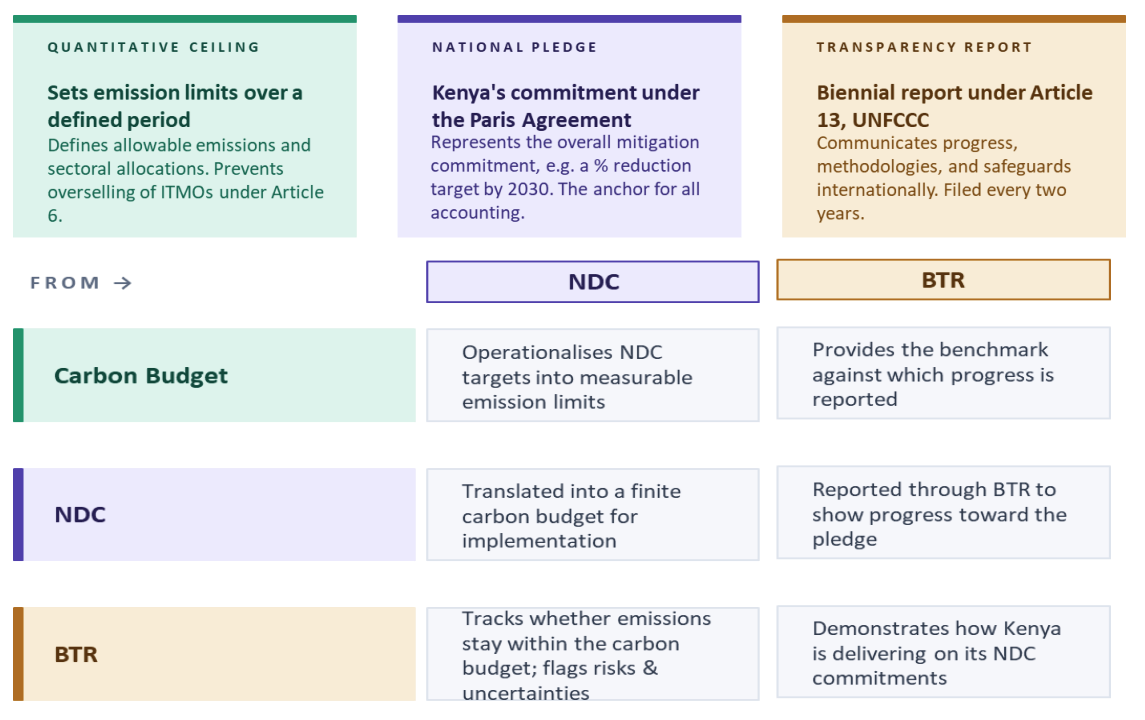
How the Guide relates the three instruments. The NDC is the commitment; the carbon budget translates it into a finite quantitative limit with sectoral allocations, guarding against overselling of ITMOs under Article 6; the Biennial Transparency Report tracks whether emissions stay within that budget and reports progress to the UNFCCC. Source: Kenya Guide for Strategic Engagement in Carbon Markets, §3.1.1. Alt text: Matrix showing the relationship between Kenya's carbon budget, NDC and Biennial Transparency Report. ]
Section 3.1.1 further states that the initial budgets rest on "a single retention factor value" and that different retention factors will in future be applied across sectors. The factor is not published, so the 10 Mt figure cannot be reproduced from the NDC arithmetic above.
The Guide sets out three instruments, issued separately by the Designated National Authority, each resting on a distinct evidence base.
Letter of No-Objection. Issued on a project concept note. Confirms Government does not object in principle to the activity being developed in Kenya and permits progression to a Project Design Document. Section 3.2.3 states it is not an approval and does not constitute an authorisation. Section 3.2.3 lists seven screening categories; Annex 2 lists eight, adding methodological credibility. Annex 2 also requires an ESIA report and its licence at this stage.
Letter of Approval. Issued on a validated PDD. Confirms the activity's design meets national expectations and may attach conditions. Annex 3 sets out the supporting evidence: executed land tenure, a county letter of support, sector permits, a community development agreement for land-based projects on public or community land, signed benefit-sharing, FPIC evidence, gender-disaggregated consultation records, an operational grievance mechanism and validation by an accredited VVB.
Letter of Authorisation. Permits international transfer under Article 6 and triggers corresponding adjustment where required. Section 3.2.5 sets nine pre-requisites before the six authorisation criteria are applied. Among them: authorisation is ex-post only — available only to activities fully implemented, monitored, independently verified and issued; only vintages of 2025 or later are eligible; voluntary projects operating outside a bilateral arrangement do not qualify, and the Guide states their outcomes "shall be applied exclusively toward meeting Kenya's NDC commitments"; and the corresponding adjustment fee set in the Second Schedule of the Carbon Markets Regulations must be paid in full prior to issuance of the letter.
Timeliness appears as an objective in Sections 1.3 and 2.2. No stage in Section 3.2 carries a determination period, and Section 4.1.2 sets no service standard for the DNA or the Climate Change Directorate.
The practical consequence is that each gate carries cost and none commits the next, and that no sovereign instrument bearing on transferability exists until credits have been issued.
Annex 5 excludes the Forestry and Other Land Use sector from the whitelist for the current NDC implementation period, on reversal-risk grounds and pending improvement of baseline data. Section 3.3.1 states that activities not on the whitelist may still be considered for authorisation, subject to more rigorous justification and scrutiny, and that exclusion does not bar participation in the PACM or the voluntary carbon market.
Annex 1 lists the sectors covered by the budget as Energy, Transport, IPPU and Waste. The authorisation criteria in Annex 4 require cumulative volumes to be assessed against remaining headroom, including interaction with sector allocations.
These provisions are not reconciled in the text. A land-based request would, on the face of the document, be assessed against headroom the budget table does not allocate to it. Sectoral allocations are referenced as an assessment input but are not published, and Section 3.1.3 states that the approach for allocating the budget, particularly as it nears exhaustion, will be defined later through periodic allocations. Section 4.1.1 commits to tracking the running balance but not to publishing it.
Written clarification from the Climate Change Directorate on the status of the Section 3.3.1 discretionary route would resolve the question for land-based developers.
Annex 5 gives a worked example for the FOLU exclusion: Kenya's Forest Reference Emission Level does not currently cover rangelands.
Kenya's largest land-based carbon activity operates in that category. The Northern Kenya Rangelands Carbon Project spans more than 1.9 million hectares across community conservancies, applies VM0032 for rangeland and grassland management, and is described by its proponents as the largest soil carbon removal project in the world. It resumed issuance in June 2026 following the conclusion of a Verra quality control review, after several years of litigation and scrutiny over governance and consent.
The whitelist's nine activity types are distributed solar PV, solar mini-grids and standalone systems, utility-scale solar with storage, geothermal, hydro and wind at utility scale, industrial electrification and efficiency, electric vehicles with renewable charging, modal shift of freight and passengers, landfill gas capture and utilisation, and composting or anaerobic digestion with energy recovery. Improved cookstoves and household fuel switching, which have accounted for a substantial share of Kenyan credit issuance over the past decade, do not appear.
The whitelist's composition therefore differs materially from the current composition of Kenya's issuing project base. The Act defines the whitelist as a non-binding, non-exhaustive list of preferred activity types, so the two need not coincide — but the divergence is worth noting when reading the document as a signal of Government priorities.
Annex 5 sets out the FOLU exclusion in conditional terms. Under core consideration 2, it states that sectors without credible data for baseline determination shall not be included in the whitelist, until such data becomes available. Consideration 4 then names the specific gap in Kenya's Forest Reference Emission Level.
The Guide attaches a review cadence to this. Section 4.2 commits the Directorate to a biennial review and stocktake, informed by stakeholder consultation, and to a consolidated updated version of the Guide within 18 to 24 months. Section 3.3.3 provides for whitelist review annually, or when relevant standards and methodologies change, with publication through official channels.
The exclusion is therefore written as a condition with a stated unlock and a scheduled reconsideration, rather than as a permanent bar.
Annex 5 also records a preference on the measurement side: activities integrating digital MRV systems for real-time tracking shall be preferred, alongside mandatory Article 13 transparency compliance and a stated preference for methodologies with established track records. Annex 3 criterion 3 sets out the corresponding MRV requirements — defined parameters, frequency, responsibilities, quality control and data-management systems.
Section 3.2.8 departs from the register of the rest of the document. It opens "The Parties expressly acknowledge and agree that the issuance of this Letter of Authorisation…" and refers throughout to "this LoA" and "the Project Developer". The Guide does not state whether the subsection is a mandatory term of every Letter of Authorisation, an extract from a template, or narrative description.
Its substance is a liability disclaimer. It provides that issuance is strictly an administrative and regulatory accounting action, and that the Government of Kenya disclaims liability for developer default or insolvency; for breach of loans, credit facilities, green bonds or other debt instruments secured or leveraged using the LoA or prospective corresponding adjustments as security or collateral; and for failure of commercial insurance, political risk insurance or credit guarantees, including but not limited to products issued by the Multilateral Investment Guarantee Agency. It states that the LoA does not constitute a sovereign guarantee, financial warranty or indemnity.
Read alongside the ex-post authorisation rule, the absence of a queue or reservation mechanism, and the fact that the running balance is tracked rather than published, the subsection is relevant to how pre-issuance finance for Kenyan Article 6 activity can be structured. The operative template is worth obtaining before downstream commitments are made.
The rest of this piece describes the document. This section is our reading of it.
Kenya has published its constraint, in public, with the supporting arithmetic attached. Comparatively few host countries have. Whatever one makes of the level at which the ceiling is set, a published ceiling is easier to build against than an unpublished one, and the Guide is a real advance in legibility.
For land-based activity, the document also relocates the binding constraint. The stated obstacle to Article 6 authorisation is now, explicitly, baseline data of a quality the state is prepared to underwrite a corresponding adjustment against — with rangeland baselines as the named example. In our experience, closing that gap means original fieldwork: calibrated allometry, ground-truthed biomass, and tenure and consent documentation assembled to a standard an investment committee recognises.
That is first-mile work, and it is the same constraint we described in our reading of Gaining Ground — that the enabling infrastructure meant to make nature investable is scarcest where nature is least investable. Kenya has now stated the condition explicitly and attached a review date to it.
The ex-post rule points in the same direction. Where no sovereign instrument exists until credits have been issued, expenditure before that point rests on the strength of the underlying measurement. That raises rather than lowers the value of a defensible baseline.
It is also worth being precise about what is closed and what is not. No-Objection and Approval apply to all activity types regardless of whitelist status. Land-based projects can be developed, approved, issued and sold into the voluntary market, and can contribute to Kenya's domestic NDC. What is unavailable is authorisation for international transfer, and therefore the corresponding adjustment — which is decisive for some buyers and immaterial to others. A Kenya position that does not depend on adjusted units remains viable under the current framework.
We have built an interactive review tool for the Guide: the full text by section, twenty-seven findings tagged by type and severity and cited to source, the three decision gates, and all 130 assessment criteria from Annexes 2–4 as a working readiness checklist with exportable notes. Open the RAMO review tool for Kenya's carbon markets guide.
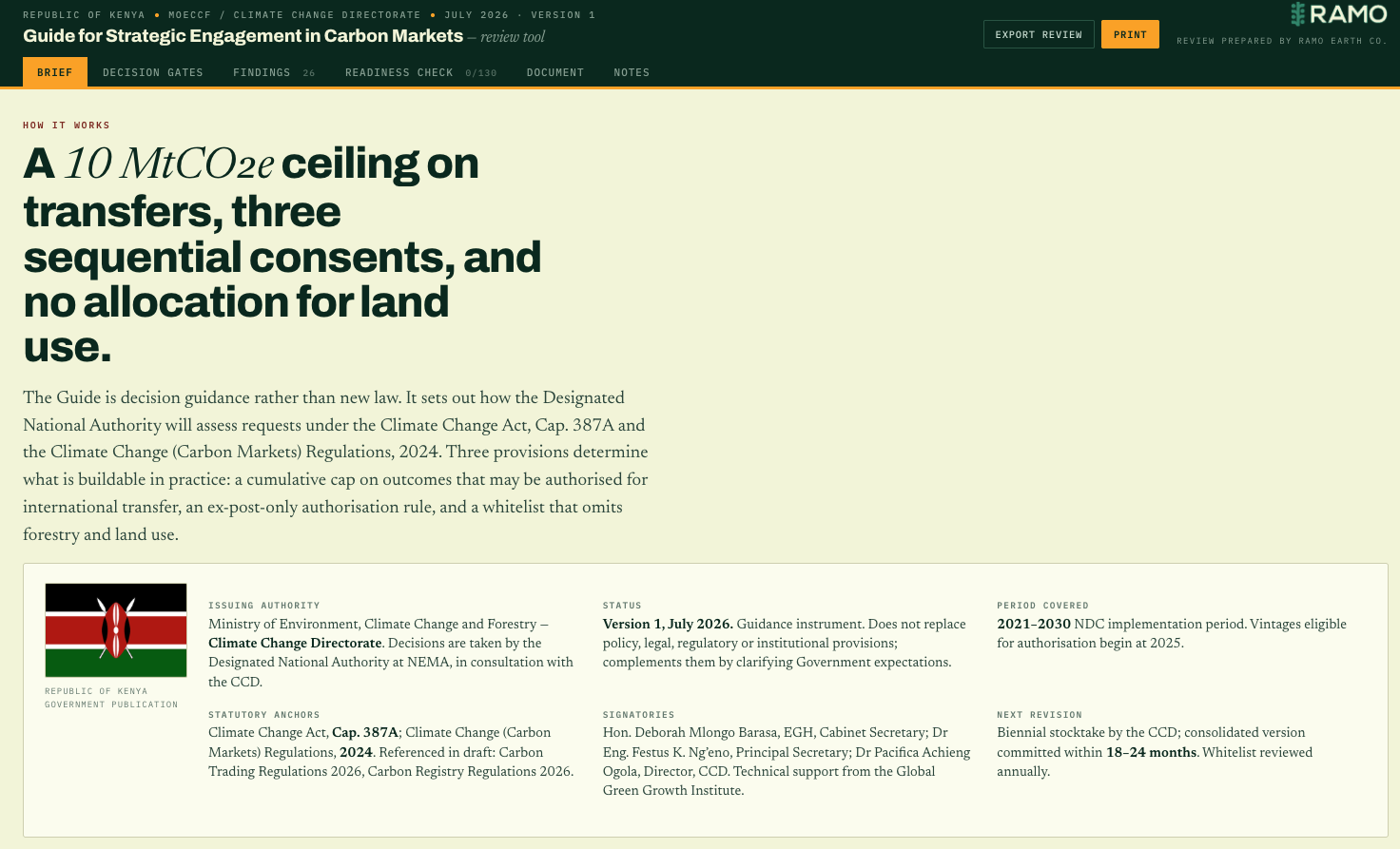
Government of Kenya (2026). Guide for Strategic Engagement in Carbon Markets. Ministry of Environment, Climate Change and Forestry, Nairobi. Version 1, July 2026. Developed with technical support from the Global Green Growth Institute. Available on the Kenya Climate Change Knowledge Portal (kcckp.go.ke).
Republic of Kenya. Climate Change Act, Cap. 387A; Climate Change (Carbon Markets) Regulations, 2024.
Associated Press (2026). Kenya unveils carbon market rule book and caps the overseas sale of carbon credits, 4 August 2026 (article).
Business Daily Africa (2026). Kenya caps carbon credit exports to shield domestic goals (article).
Northern Rangelands Trust (2026). Northern Kenya Rangelands Carbon Project returns to the market following conclusion of Verra Section 6 review, 18 June 2026 (article).
Section references, the arithmetic above and the observations on unreconciled provisions are RAMO Earth Co.'s analysis of the published document. They are not statements of the Government of Kenya.


