
#NatureFinance #NaturalCapital #CarbonMarkets #Africa #MRV #FirstMileData
Forest Trends and The Nature Conservancy have published Gaining Ground: State of Private Investment in Nature 2026, a decade-on follow-up to their 2016 benchmark study. It tracks 1,731 nature-related transactions between 2016 and 2025, supplemented by a survey of 70 investors representing $207 trillion in assets under management.
The headline is genuinely good news. Private capital committed to nature reached more than $14 billion in 2025, against $2.8 billion in 2016 — roughly a fivefold increase. Across the decade, at least $61.4 billion was committed, with a further $183.5 billion in allocations already announced for the years ahead. Tracked investments now touch approximately 105 million hectares, an area about twice the size of Spain.
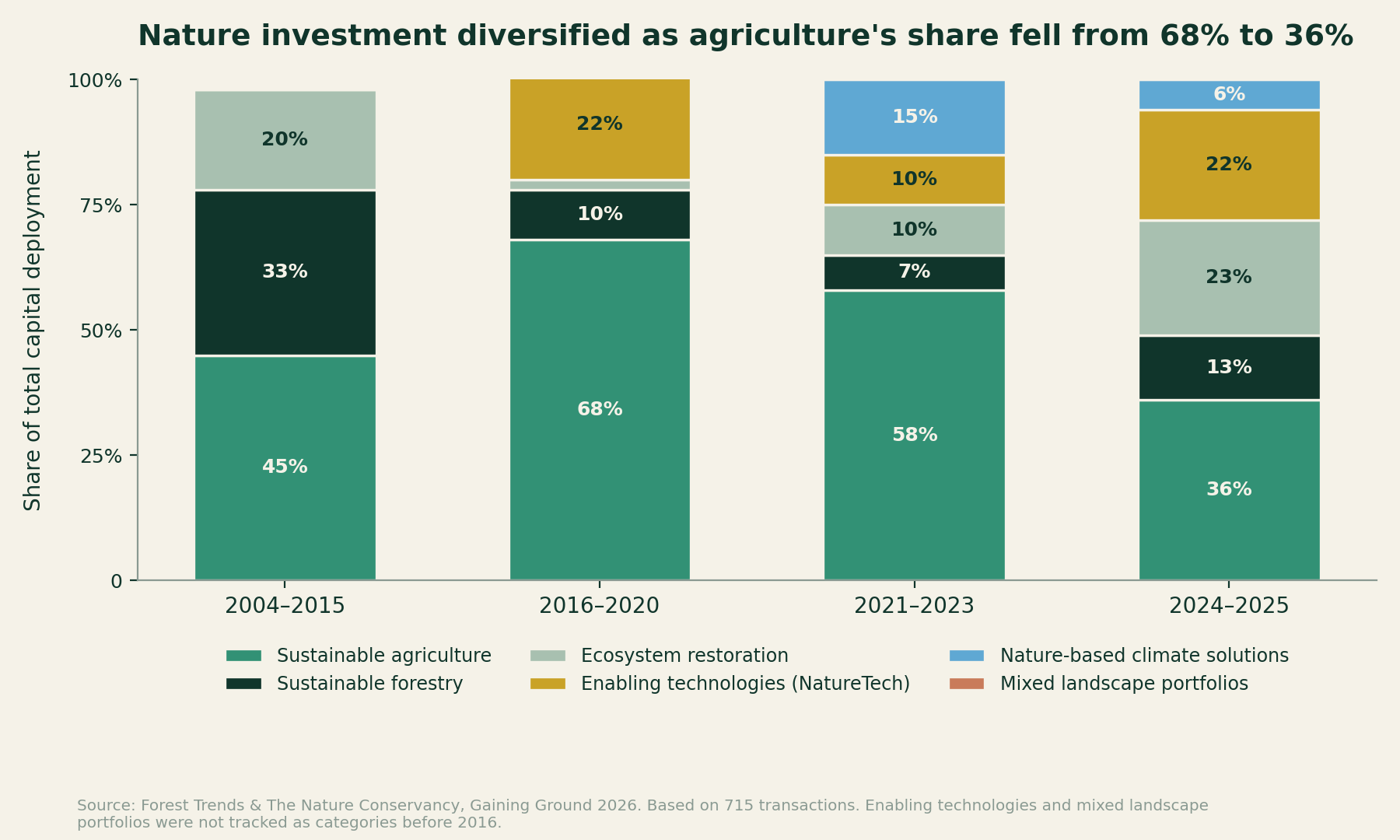
More interesting than the growth is the diversification. Sustainable agriculture absorbed 68% of allocations between 2016 and 2020; by 2024–2025 that had fallen to 36% — not because agriculture shrank, but because everything around it grew faster. Ecosystem restoration now accounts for 23% of recent deployment, enabling technologies 22%, sustainable forestry 13%, and nature-based climate solutions 6%.
Writing for the World Economic Forum, the report's lead author Genevieve Bennett frames this as four bets that investors have started to win: ecological restoration in the United States has become dull enough to attract pension money; Latin American reforestation can now be financed at billion-dollar scale; regenerative agriculture beats an already-strong farmland baseline; and carbon positions can be held while market infrastructure catches up.
All four are well evidenced. None of them are about Africa.
Break the decade's capital down by destination and the distribution is stark. North America received $20.8 billion. Latin America followed at $15.3 billion. Asia and Oceania took $6.3 billion each, and Europe $4.1 billion. Africa received $2.3 billion.
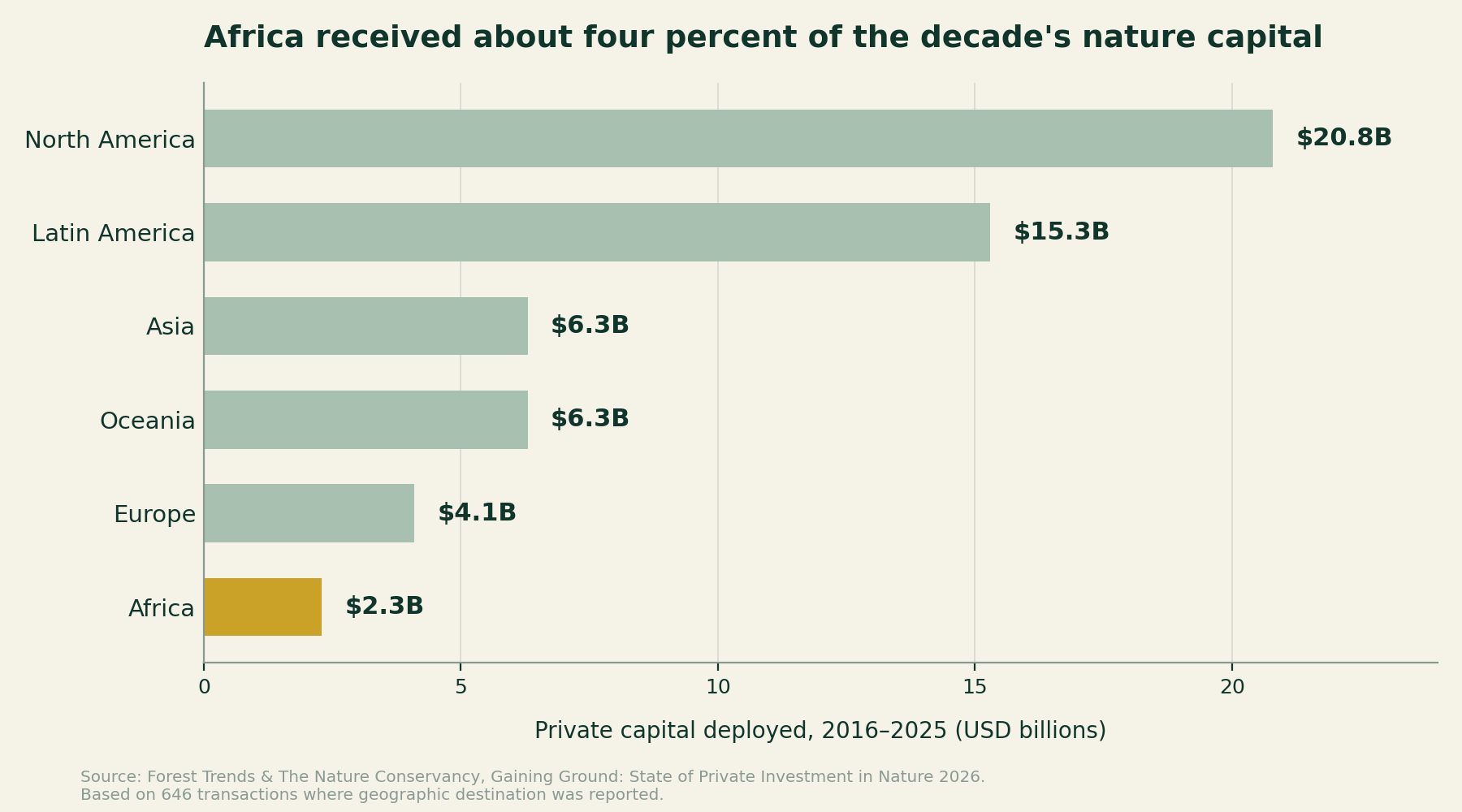
That is roughly four percent of the nature capital whose destination was disclosed. Latin America alone took 28%. On land area the picture is similar: of the 105 million hectares under some form of nature-related management, Africa accounts for 5.8 million, against 41.5 million in North America and 39.3 million in Asia.
This is not a continent short of the underlying asset. Africa holds some of the highest-biodiversity, most conversion-threatened landscapes on earth, including the miombo woodlands stretching across Angola, Zambia, Mozambique, Tanzania and Malawi — one of the largest dry forest systems in the world, and among the least measured.
Gaining Ground does not leave the gap unexplained. Its authors attribute Africa's small share to three things: perceived transaction risk, thin enabling infrastructure, and a limited base of established managers with the capacity to execute on the ground.
The ordering matters. Only the first of those three is about risk appetite. The other two are about supply — about whether there is anything investable to underwrite in the first place, and anyone credible to deliver it.
That distinction changes what the problem is. If African nature investment were constrained by risk perception alone, the fix would be de-risking instruments: guarantees, first-loss tranches, political risk insurance. Those exist and they help. But if the binding constraint is that projects cannot be brought to a standard an institutional allocator can diligence, then no amount of credit enhancement moves the number. You cannot guarantee your way past an absence of baseline data.
The report supports this reading elsewhere. Across 93 ecosystem restoration and conservation investments in Latin America, Asia and Africa, not one reported revenue from biodiversity or nature credits. In North America, Europe and Oceania, seven of eight did. The difference is not ecological. It is that those markets have measurement standards, regulatory demand, and a decade of transaction precedent.
The report's newest category is enabling and commercialisation technologies — the MRV platforms, earth-observation analytics, traceability systems and transaction infrastructure underpinning every other category. It did not exist as a category in 2016. It is now second only to sustainable agriculture by deal count, having attracted $11.8 billion over the decade.
Its geography is worth sitting with. Forty-six percent of that capital went to North America and 39% to Latin America. Asia took 7%. Africa and Oceania together accounted for 3%.
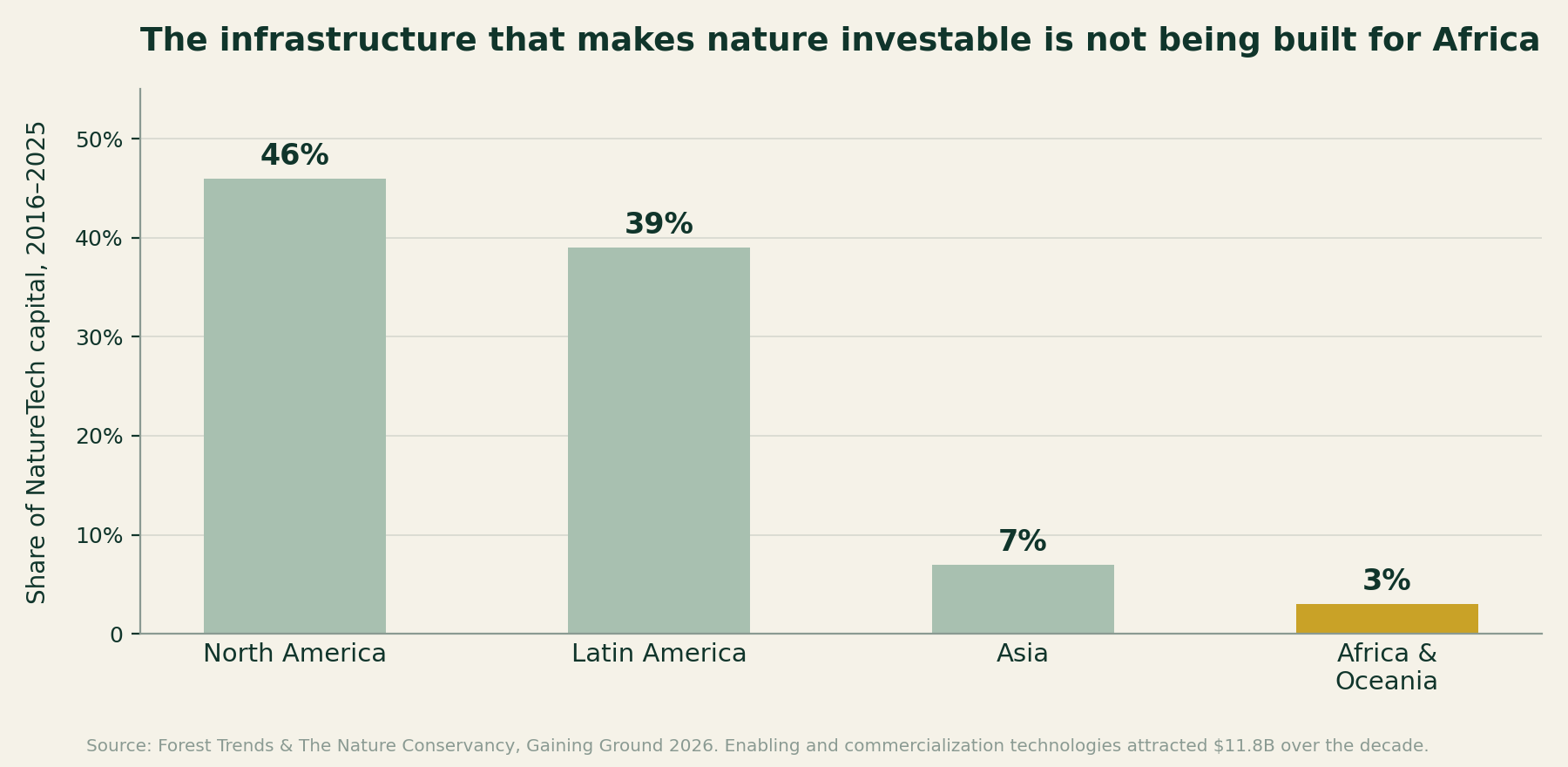
So the infrastructure whose entire purpose is to make nature investable is being built almost exclusively for the places where nature is already investable. The regions with the thinnest enabling infrastructure are receiving the least investment in enabling infrastructure. That is a self-reinforcing loop, and it will not break on its own.
There is a parallel gap in what gets measured. The report finds carbon metrics comparatively mature, benefiting from decades of methodology development and voluntary market discipline. Biodiversity, soil health, water quality and community outcome metrics have not converged in the same way — even as third-party framework adoption rose from 21% of respondents in 2014 to 59% in 2025. Where measurement is immature, revenue is unpriceable; where revenue is unpriceable, capital stays home.
In April 2026, BTG Pactual's Timberland Investment Group closed a $1.24 billion Latin American reforestation fund — among the largest private timberland vehicles ever raised. Roughly half the land is destined for commercial plantation, the other half for native species restoration and protection, with revenue stacked across FSC-certified timber, carbon credits and other ecosystem services, and catalytic public capital from the UK and Dutch governments inside the structure.
A fund of that shape does not appear because someone decided Brazil deserved one. It appears on top of an accumulated base: a functioning land registry, decades of timberland transaction precedent, a domestic manager with operating scale, established restoration science for the Cerrado, and a research partnership with a national university to refine it.
Miombo has none of that stack. Not because the ecology is less valuable, but because the intermediate layer between a landscape and an investable asset has never been built there. Allometric equations calibrated for miombo species are scarce. Baseline biomass data is sparse and rarely ground-truthed. Land tenure documentation is fragmentary. Community consent processes are frequently undocumented in any form an investment committee would recognise.
Each of those is a solvable engineering problem. None of them is solved by capital arriving.
There is a further constraint the report names directly, in a contributed essay on what its authors call financing integrity. Most institutional investors and specialist funds carry minimum cheque sizes somewhere between $5 million and $50 million, because legal, tax and diligence costs have to be spread across enough capital to justify them.
Many high-integrity nature projects — particularly those originated by communities, local organisations or first-time developers — simply do not start at that size. The result is a structural mismatch in which credible projects are effectively too small to finance under prevailing models. The available workaround is aggregation, but aggregation carries its own cost: decision-making and economics tend to migrate toward the centre of the structure and away from the people whose land it is.
This is the mechanism by which a market can be simultaneously well capitalised and unable to fund the projects that most need funding. It also explains why grouped and jurisdictional project architectures — where multiple smaller activities share a single methodology, baseline and verification pathway — are not merely an administrative convenience. They are the difference between financeable and not.
The optimistic reading of Gaining Ground is that nature has become a real asset class. We think that reading is correct, and we would add that it makes the African gap more urgent rather than less. A maturing market allocates on evidence. Regions that cannot produce evidence do not simply get a smaller allocation — over time they stop being considered.
Our view is that the first mile is where this is decided. Before a fund structure, before an offtake, before a rating, there is a prior question of whether anyone can say with defensible precision what carbon is standing on a given hectare, who holds rights to it, what the counterfactual is, and how any of it will be monitored across a twenty-year crediting period. In most of Lusophone Africa, answering those questions currently requires original fieldwork, because the underlying data does not exist in usable form.
That is unglamorous work. It is also the constraint. The $700 billion annual nature finance gap identified by the Kunming-Montreal framework and the World Economic Forum will not be closed by better instruments alone, because instruments price risk — they do not create the information needed to price it.
The encouraging part of the report is that this pattern has broken before. US mitigation banking became a pension-grade asset class not through advocacy but because the 2008 Mitigation Rule specified precisely what a credit was, what earned one, and what a buyer received. Clarity preceded capital. Asked what would most expand investment, survey respondents gave versions of the same answer: predictable demand and consistent standards.
Africa's nature markets need the same sequence — the measurement layer, the tenure layer and the community consent layer, built to a standard an institutional allocator recognises. Get that right and the capital is demonstrably available. There is $183.5 billion already announced and looking for somewhere to go.
We have built an interactive review tool that lets you work through the report's findings by region, investment category, investor type and time period, including the geographic breakdowns discussed above. Open the RAMO NatureOS report review tool.
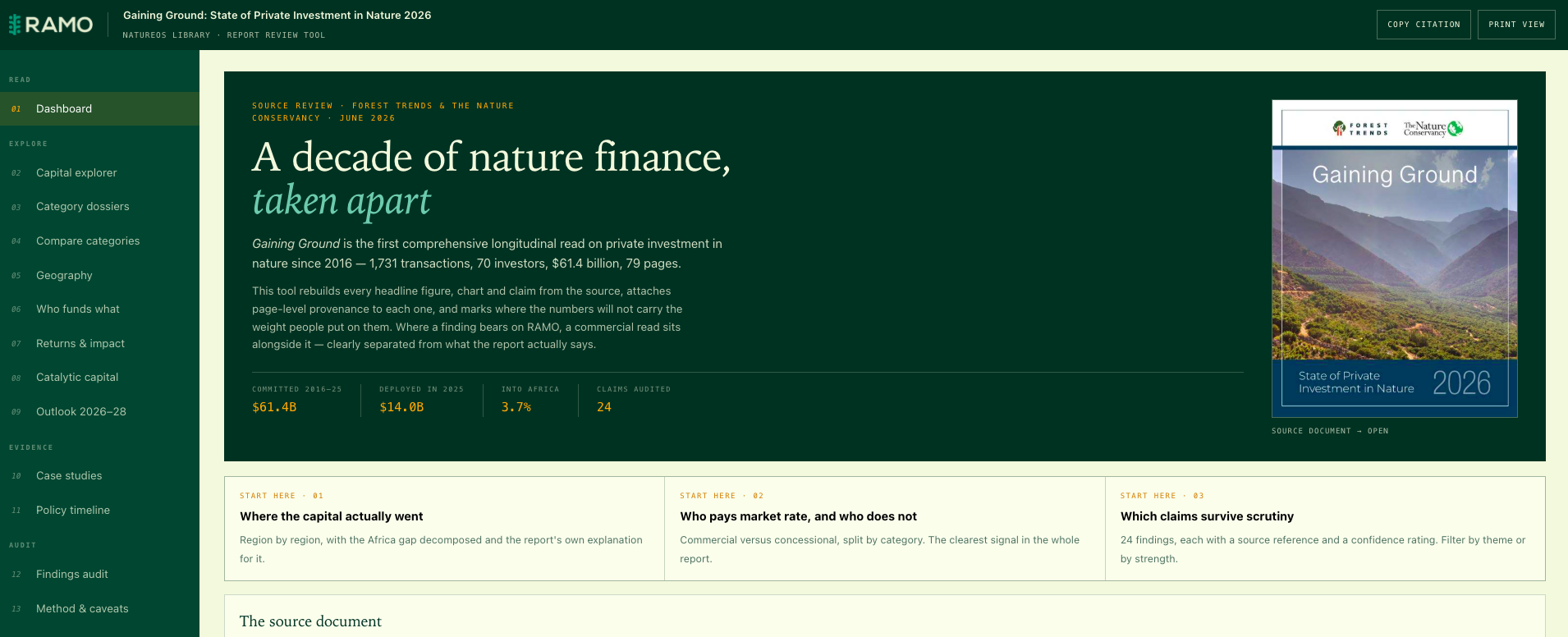
Bennett, G., Lucena, L., Burns, C., and Watkins, K. (2026). Gaining Ground: State of Private Investment in Nature 2026. Forest Trends' Ecosystem Marketplace and The Nature Conservancy (report).
Bennett, G. (2026). Which nature investments pay off? Here's what a decade of data says. World Economic Forum, 5 August 2026 (article).


